Santorini’s Position in the Aegean Sea
Santorini sits in the southern Aegean Sea, roughly 200 kilometres southeast of mainland Athens. It belongs to the Cyclades island group, a collection of around 220 islands that scatter across the central Aegean in a rough circular pattern. Geographically, Santorini is one of the most southerly of the Cyclades, placing it closer to Crete than to Athens. Its coordinates put it at approximately 36 degrees north latitude, which translates to long, warm summers and mild winters by Greek standards.
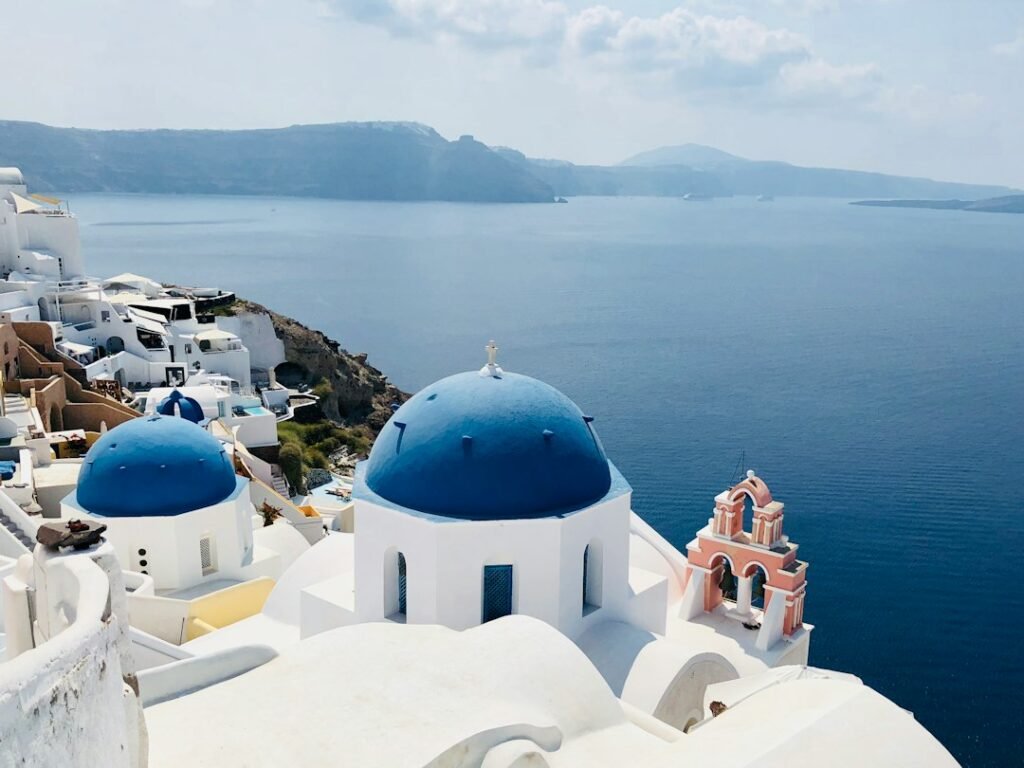
The island itself is actually the rim of a massive ancient volcanic caldera. Around 3,600 years ago, one of the largest volcanic eruptions in recorded human history reshaped this part of the Aegean entirely. What remains today is a crescent-shaped main island called Thira, along with smaller islands including Thirasia and the still-active volcanic islets of Nea Kameni and Palea Kameni in the centre of the caldera. That geography is the reason the island looks so dramatically different from almost anywhere else in the Mediterranean. The cliffs on the western side drop hundreds of metres straight into the caldera, while the eastern coast slopes gradually toward the sea.
Getting there is straightforward in 2026. Santorini has its own international airport, Thira National Airport, with direct seasonal flights from across Europe and connecting flights via Athens year-round. Regular high-speed ferries run from Piraeus port in Athens, taking around five hours, while slower conventional ferries take closer to eight. Fast ferries also connect Santorini with neighbouring Cyclades islands like Mykonos, Naxos, and Paros, making island-hopping very practical.
What the Location Means for Exploring Santorini by Sea
Santorini’s volcanic origins and its position in the open Aegean create some of the most remarkable sailing conditions in Greece. The caldera is essentially a sheltered natural harbour surrounded by sheer cliffs, making it an ideal base for boat trips. The Meltemi wind, a seasonal northern wind that picks up in the Aegean from June through August, keeps the water cool and the skies clear, though it can occasionally make sailing on the open eastern side of the island choppy in the afternoons.
Most sailing routes around Santorini focus on the caldera itself, giving passengers close-up views of the cliffs at Oia, the black and red volcanic beaches at Akrotiri, and the hot springs near the volcanic islets. A Santorini private catamaran cruise with BBQ is one of the most popular ways to take in the caldera landscape, combining swimming stops with a proper meal on the water. For those who want to time their trip around the famous sunset, a Santorini luxury catamaran sunset cruise positions you directly on the water as the sun drops behind the caldera rim, a view that no clifftop bar can fully replicate.
The island is small enough that a single day on the water covers the highlights comfortably. The caldera’s width from rim to volcanic islet is only about six kilometres, so distances are manageable even on a half-day trip. Water temperatures in the caldera hover around 24 to 26 degrees Celsius in peak summer, warm enough for long swimming stops without any discomfort.
If you want to pair a sailing experience with time ashore, combining a cruise with a land tour makes good sense. A Santorini highlights private tour covers the key villages, viewpoints, and archaeological sites that a boat simply cannot reach, giving you a complete picture of the island beyond its famous waterline silhouette.